Pertelote
The Canterbury TalesPertelote is Chanticleer’s fairest hen and closest companion, presented not as a silent member of the flock but as a speaking, judging presence within the domestic world of the farmyard. Her beauty, courtesy, and confidence shape the interpretation of Chanticleer’s dream, making her one of the central agents in the story’s debate over fear, knowledge, and action.
Identity and Place in the Farmyard
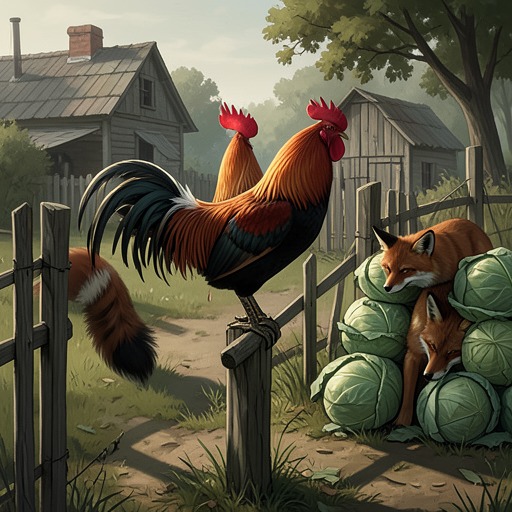
Pertelote belongs to the enclosed yard where an exceptional cock named Chanticleer rules a flock of seven hens. The flock is described through the language of household and sexual hierarchy: the hens are Chanticleer’s paramours and sisters, while Pertelote is singled out as the one with the fairest coloring on her throat. She therefore occupies a privileged position among the hens, distinguished not only by appearance but also by the attention given to her in the narrative.
Her physical beauty is joined to a social quality. Pertelote is called discreet and gentle and is associated with courtesy, qualities that make her more than an ornamental bird. The description gives her a recognizable character before she speaks: she belongs to the farmyard’s intimate community, yet she possesses enough distinction to answer Chanticleer as an equal conversational partner.
Marriage and Conversation with Chanticleer
Pertelote’s relationship with Chanticleer is presented as a marriage-like partnership. When Chanticleer rests on his perch with his seven wives, Pertelote is beside him as the fairest among them. Their closeness is immediately tested when Chanticleer begins to groan in his sleep like a troubled human dreamer. The scene turns an ordinary domestic moment into a conversation about the meaning of dreams and the authority to interpret them.
Chanticleer explains that he has seen a frightening vision and that the memory of its appearance makes him fear death. Pertelote does not respond by sharing his alarm. Instead, she rebukes him for becoming faint-hearted and tells him that he has lost her heart and love. Her words make affection conditional upon courage: in her judgment, fear is not merely an inward sensation but a failure that damages the standing of a male partner before his mate.
This exchange also establishes Pertelote as a corrective voice. Chanticleer treats the dream as a possible warning, whereas Pertelote dismisses his distress and attempts to restore ordinary confidence. She speaks with emotional authority, using the language of love to pressure him back into composure. The marriage is consequently both affectionate and argumentative; intimacy gives her the power to challenge him, while her challenge reveals how quickly tenderness can become judgment.
Judgment, Fear, and the Limits of Counsel
Pertelote’s response to the dream places her within the fable’s larger interest in competing kinds of knowledge. Chanticleer’s groaning and fear are rooted in sensation and vision, while Pertelote answers with confidence and practical dismissal. She does not occupy the passive role of a listener waiting for the cock to decide what danger means. Her interpretation actively shapes his understanding of his own experience.
The later knowledge of a black-marked fox living for three years in the nearby grove gives the dream an ominous context. The fox is described as iniquitous and sly, and its proximity to the farmyard makes the threat concrete rather than imaginary. Against that danger, Pertelote’s earlier contempt for Chanticleer’s fear appears sharply ironic. Her confidence may be socially powerful and emotionally reassuring, but it does not protect the flock from an enemy who is already established nearby.
That irony does not reduce Pertelote to a foolish character. The narrative gives her a humane and articulate position: she resists panic, preserves her own dignity, and refuses to let an uncertain vision govern the household. Yet the fable also exposes the danger of treating fear as mere weakness. Chanticleer’s dream belongs to a chain of signs that the audience can recognize more fully than the characters do, so Pertelote’s certainty becomes part of the story’s suspense.
Animal Subjectivity and Narrative Function
Pertelote’s importance depends on the way the tale grants animals forms of speech, desire, social rank, and domestic conflict. The surrounding book often presents animals as objects of human pity, labor, property, or sport: charity is measured by compassion for a mouse caught in a trap, a forest attendant takes pleasure in tracking the hare with swift greyhounds, and a strong miller’s physical power is described through the damage he can inflict on doors. Pertelote belongs to a different category. She is not merely observed or used; she participates in interpretation and argument.
Her voice gives the farmyard an internal society with its own standards. Courage, love, beauty, courtesy, and reputation matter among the birds, and the emotional consequences of a dream are negotiated within their relationship rather than explained solely by a human narrator. Pertelote therefore functions as a narrative subject in her own right, even though the fable also uses the birds to reflect human habits of marriage, authority, and debate.
The contrast between her domestic presence and the fox’s predatory presence intensifies the tale’s structure. Pertelote represents the intimate world of the yard, where Chanticleer sings and the hens rest together; the fox represents the concealed external danger that has been waiting nearby. Her confidence makes the household seem secure, while the fox’s long residence in the grove reveals that security to be fragile.
Ending and Significance
Pertelote’s surviving significance is concentrated in the tension between her confidence and the danger that follows. She is remembered beside Chanticleer, lying happily in the sand with her sisters while his throat makes its merry song. That image returns the story to the visible routines of the flock, but it carries the shadow of the fox and the earlier dream. Cheerfulness and vulnerability occupy the same scene.
As Chanticleer’s mate, Pertelote helps make the fable a story of companionship rather than a solitary animal adventure. As the critic of his fear, she forces the tale to test the value of instinct against rational dismissal. As a female animal with beauty, courtesy, speech, and judgment, she enlarges the narrative’s animal world beyond symbolism alone. Her presence shows that the farmyard has its own emotional and political life, even as the humanly shaped fable turns that life toward questions of prudence, persuasion, and the peril of mistaking confidence for safety.